CLAUDIA ZAPATA IS A SPECIALIST IN LATINE AND CHICANX ART.
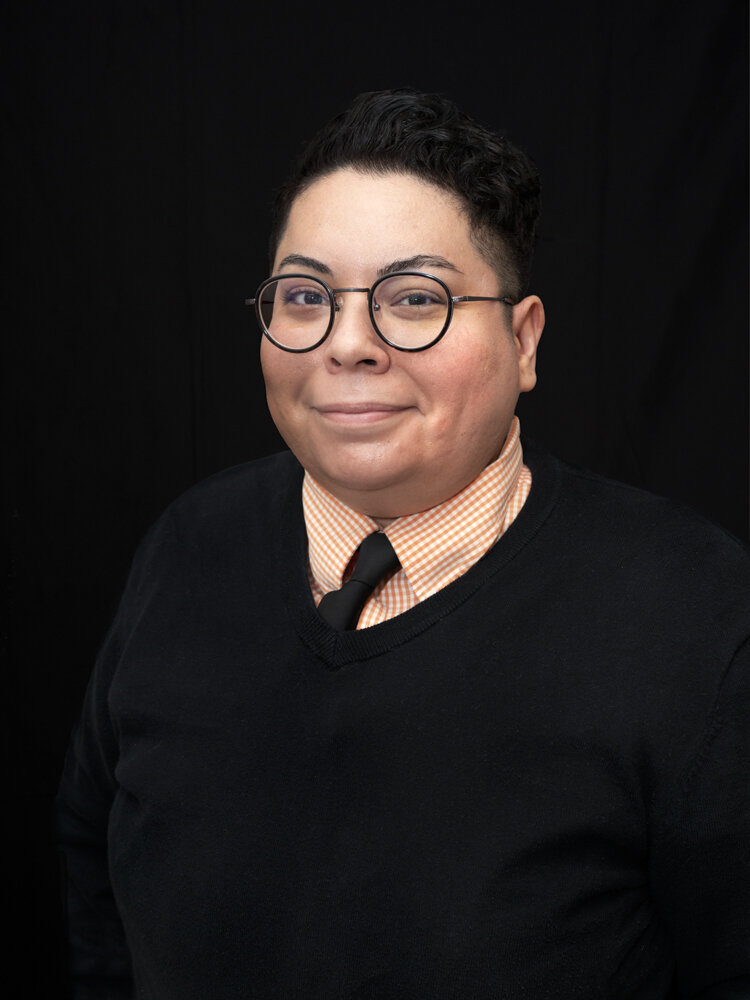
Claudia E. Zapata (they/them) earned their Ph.D. in art history at Southern Methodist University’s RASC/a: Rhetorics of Art, Space, and Culture program. Their dissertation is titled “Chicano Art is Not Dead: The Politics of Curating Chicano Art in Major U.S. Exhibitions, 2008-2012.” They earned their BA and MA in art history from the University of Texas at Austin, specializing in Maya art of the Classic period (250-900 CE).
Zapata was the curator of exhibitions and programs at the Mexic-Arte Museum in Austin. They developed several Texas exhibitions, including A Viva Voz: Carmen Lomas Garza (2009), Sam Coronado: A Retrospective (2011), and Fantastic & Grotesque: José Clemente Orozco in Print (2014). From 2018-2022, Claudia was the curatorial assistant of Latinx art at the Smithsonian American Art Museum, working on the award-winning exhibition, ¡Printing the Revolution! The Rise and Impact of Chicano Graphics, 1965-Now (2020), and curating Radical Histories: Chicanx Prints from the Smithsonian American Art Museum.
They have published articles in the academic journals Panhandle-Plains Historical Review, JOLLAS: Journal of Latino/Latin American Studies, Hemisphere: Visual Cultures of the Americas, Latin American and Latinx Visual Culture, and Aztlán: A Journal of Chicano Studies. Their essays are featured in several exhibition catalogues, including ¡Printing the Revolution! The Rise and Impact of Chicano Graphics,1965-Now, The Shape of Power: Stories of Race and American Sculpture, Let Us Gather in a Flourishing Way: Latinx Painting Today, Carmen Lomas Garza Picturing the Familiar, and Ofelia Esparza: A Retrospective (forthcoming). The edited volumes that include their work are Self Help Graphics & Art at Fifty, What We Teach When We Teach DH: Digital Humanities in the Classroom, Armando Rascón, and El Mundo Zurdo: Selected Works from the Meetings of the Society for the Study of Gloria Anzaldúa
Their work is part of USLAF’s (US Latinx Art Forum) debut writing initiative, X as Intersection: Writing on Latinx Art, with their contributing essay, “Two-Spirit Joy: Ester Hernandez’s Queer Portraiture.” Zapata now serves on the editorial board for USLAF (US Latinx Art Forum). In 2028, their edited volume on the Gilberto Cárdenas and Dolores Garcia Collection of Latino Art at the Blanton Museum of Art will be available through the University of Texas Press.
They co-founded the Latinx art project Puro Chingón Collective in 2012. This experimental art group develops zines, prints, apparel, designs, and art toys. The collective’s zines are part of the collections at the Thomas J. Watson Library at The Metropolitan Museum of Art, the Museum of Modern Art (MOMA) Library and Archives, the Benson Latin American Collection, the Museum of Fine Arts-Houston, the Mexic-Arte Museum, the National Gallery of Art, and the London College of Communication Library, among many others. Zapata’s art and design have been featured at the Hawn Gallery in Dallas, the Blanton Museum of Art, the Mexic-Arte Museum, the Trans-Pecos Festival in Marfa, Austin’s Fusebox Festival, Pachanga Music Festival, and the International Women's Day March in San Antonio.
From 2024-25, they illustrated Arborama! A Tree Game showcasing the Central Texas native trees, climate-resilient trees, and other tree species with the City of Austin’s Urban Forest Program. They were an artist-in-residence with the City of Austin (2025-2026) as part of its inaugural initiative, designed to highlight East Austin's culture. Zapata developed the Memorias Project, an immersive archival recital and installation that chronicles the history of Latina/o/x communities in Austin. For this project, they designed a participatory experience that includes original music for cello and opera voice, digital animations, and fine art prints.
Zapata is also an emerging screenwriter, playwright, and director. They were one of six finalists selected for the M Film Lab Amplifying Latinx screenwriting lab in 2022. In 2024, they participated in Teatro Vivo’s Playwright's Workshop: From Idea to Page. In 2026, their play, “Altares,” was selected as part of the 2026 Austin Latinx New Play Festival presented by Teatro Vivo. Their docushort, Texas Pride (2026), recently debuted at the Dallas Latino Film Festival.
From 2022-2023, Zapata was a Chancellor’s Postdoctoral Fellow at UCLA, mentored by Charlene Villaseñor Black, professor in the Departments of Art History and Chicana/o and Central American Studies. Their research topic was "Advancing to Web 3.0: Chicanx and Latine/x XR Immersive Environments, NFT Decentralization, and Experiential Visions in the Metaverse.” From 2023-2026, Zapata worked with conservation specialist Wendy Rose and the Smithsonian American Art Museum to create a virtual tour of Judy Baca’s Uprising of the Mujeres portable mural using the Smithsonian’s Voyager, an open-source 3D explorer.
In 2023, the Blanton Museum of Art in Austin, Texas, selected Zapata as their inaugural Associate Curator of Latino Art. Their current exhibition, There Goes My Hero: Comics and Luchadores, is on display in the Blanton’s Latino gallery. In 2025, Zapata’s curated traveling exhibition Radical Histories: Chicanx Prints from the Smithsonian American Art Museum was on view at Colby College Museum of Art (February 6- June 8, 2025), The Huntington Library, Art Museum, and Botanical Gardens (November 16, 2025- March 2, 2026), and the H’Art Museum, Amsterdam, Netherlands, (April-September 6, 2026). In 2027, the Vilcek Foundation will feature their curated exhibition, Rebel Craft: Latinx Artists Reclaiming Memory in New York.